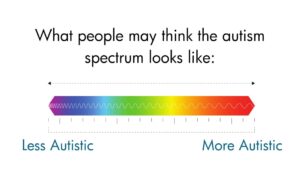
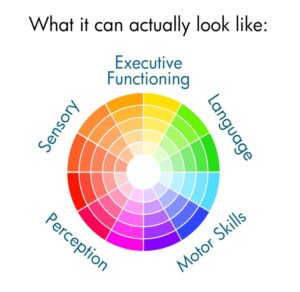
Autism or Autism Spectrum Disorder is a neurological condition that impacts how one will experience the world around them. The term spectrum reflects the unique strengths autistic individuals have; no two people will experience their autism in the same way. Although it is a lifelong disability, it is not a degenerative condition. An autistic brain, with all of its gifts and challenges, will navigate the world differently than a neurotypical individual. Autism is behaviorally diagnosed, affecting children and adults.
“According to the Diagnostic and Statistical Manual of Mental Disorders (DSM-5), a guide created by the American Psychiatric Association used to diagnose mental disorders, people with ASD have:
- Communication differences: Challenges with using and understanding spoken language, written words, and non-verbal communication such as gestures and facial expressions.
- Social interaction differences: Differences in expressing emotions and understanding the feelings, perspectives, or intentions of others.
- Repetitive behaviours and focused interests: A strong preference for routines, patterns, or specific topics, activities, or objects.
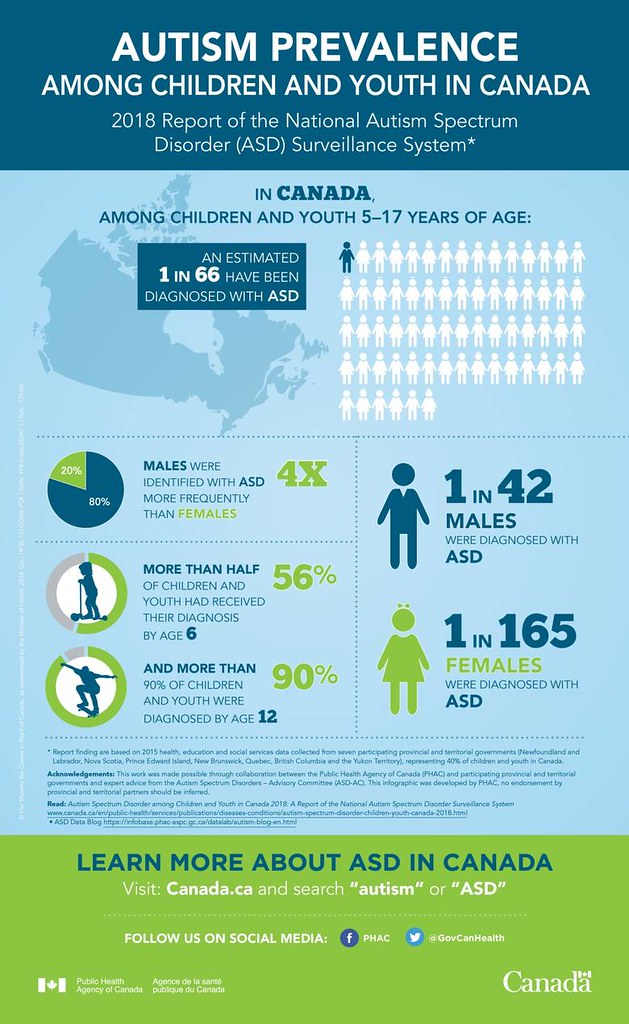
Autism is usually first diagnosed in childhood, with many of the most obvious signs presenting around 2-3 years of age. Data released in 2018 shows an autism prevalence of 1 in 66 children in Canada: 1 in 42 boys and 1 in 165 girls.
About 1 in 31 (3.2%) children aged 8 years has been identified with ASD according to estimates from CDC’s ADDM Network.
With increasing rates of diagnosis, there is a growing need for information and support for autistic individuals and their families. Understanding through education and acceptance is needed to ensure we are creating communities where everyone is understood, supported, and included by having what they need.
For more information and resources about Autism, please visit the following sites:
Autism Society Alberta~Autism Society Alberta is a network and collaboration amongst grassroots autism groups, comprising parents of children and adults with autism, family members, autistic individuals and caring community citizens.
Sinneave Family Foundation~ The Sinneave Family Foundation works to address the challenges experienced by emerging adults on the autism spectrum. Located in Calgary, the foundation provides a variety of online resources and events.
Centre for Autism Services – Alberta~ The Centre for Autism Services Alberta is the largest accredited autism service provider in northern Alberta. Its mission is to provide comprehensive and innovative supports and services to those affected by ASD.
AIDE Canada ~ AIDE (Autism and/or Intellectual Disability Knowledge Exchange Network) is a national knowledge network that is committed to providing accurate up-to-date, and useful information and resources to the people who need it.
Autism Level Up~ A collaboration between Dr. Amy Laurent, psychologist, researcher and ed. consultant and Dr. JÂcqûelyn Fede, an autistic researcher and program evaluator.
Autism Discussion Page ~ Developed by Bill Nason, MS, LLP to discuss tools that help children on the spectrum feel safe, accepted and competent.